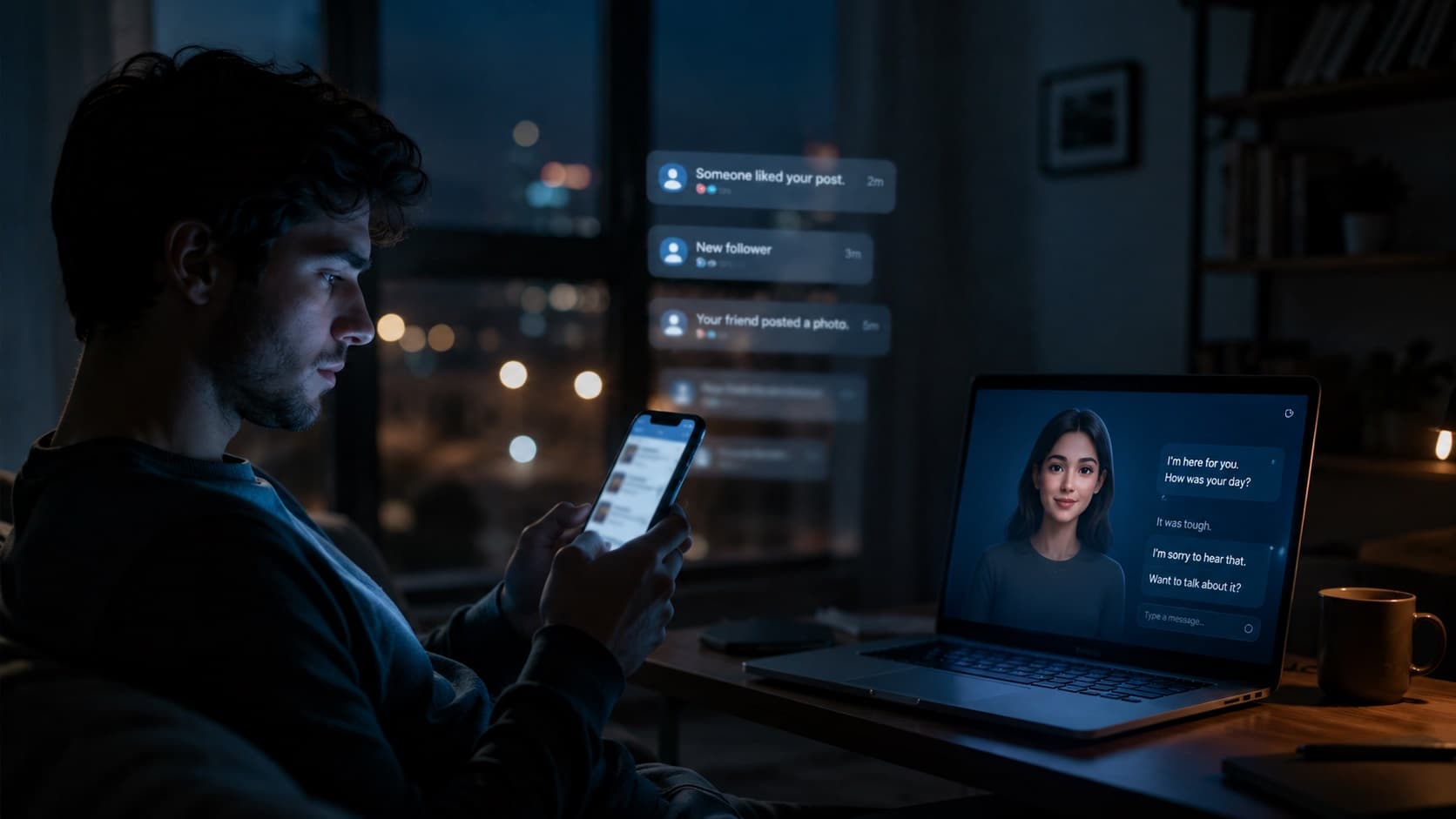
AI Companions and Loneliness: What Research Can Tell Us
People sometimes turn to AI companions for conversation when they feel lonely. A generated reply can feel attentive, but that experience raises an important question: does it help people feel more connected over time? Research offers a more cautious answer than either “AI cures loneliness” or “AI always makes it worse.”
What short-term studies found
A Harvard Business School working paper on AI companions reports that some participants felt less lonely after an AI companion conversation. Its experiments and one-week study also suggest that feeling heard mattered to participants' immediate experience. These results concern the particular systems, participants and time periods studied. They do not establish that every companion app has the same effect or that a brief improvement persists for months.
Why the longer-term picture is uncertain
A 12-month longitudinal study of more than 2,000 adults found a more complicated association. Increased social-chatbot use predicted increased loneliness on one measure; on a broader measure, people who felt less socially connected subsequently used chatbots more, while chatbot use did not significantly predict lower social connection. The authors describe the analysis as exploratory and caution against strong causal conclusions. We cannot infer from it that using a chatbot caused a person's loneliness.
The studies ask different questions and use different measures. A conversation might provide short-term comfort while the effect of frequent use over a longer period remains unclear. The evidence does not support marketing an AI companion as a treatment or replacement for human connection.
What an AI companion can and cannot offer
An AI companion can respond to what you write, continue a fictional scene and offer a low-pressure conversation. It does not have feelings, know your life beyond the information you provide, or offer mutual care in the way another person can. Generated replies can also miss context or be wrong.
If you use one, notice how you feel afterward and whether it leaves room for friends, family, communities and other relationships. The World Health Organization's report on social connection treats real social connection as important to health and well-being. If loneliness is persistent or distressing, reaching out to someone you trust or a qualified professional is a more appropriate step than relying on an app alone.
FLIRTcam is an entertainment product for character chat and roleplay, not a mental-health service. The research above is about AI companionship generally; it is not a clinical evaluation of FLIRTcam or proof of a health benefit from using it.